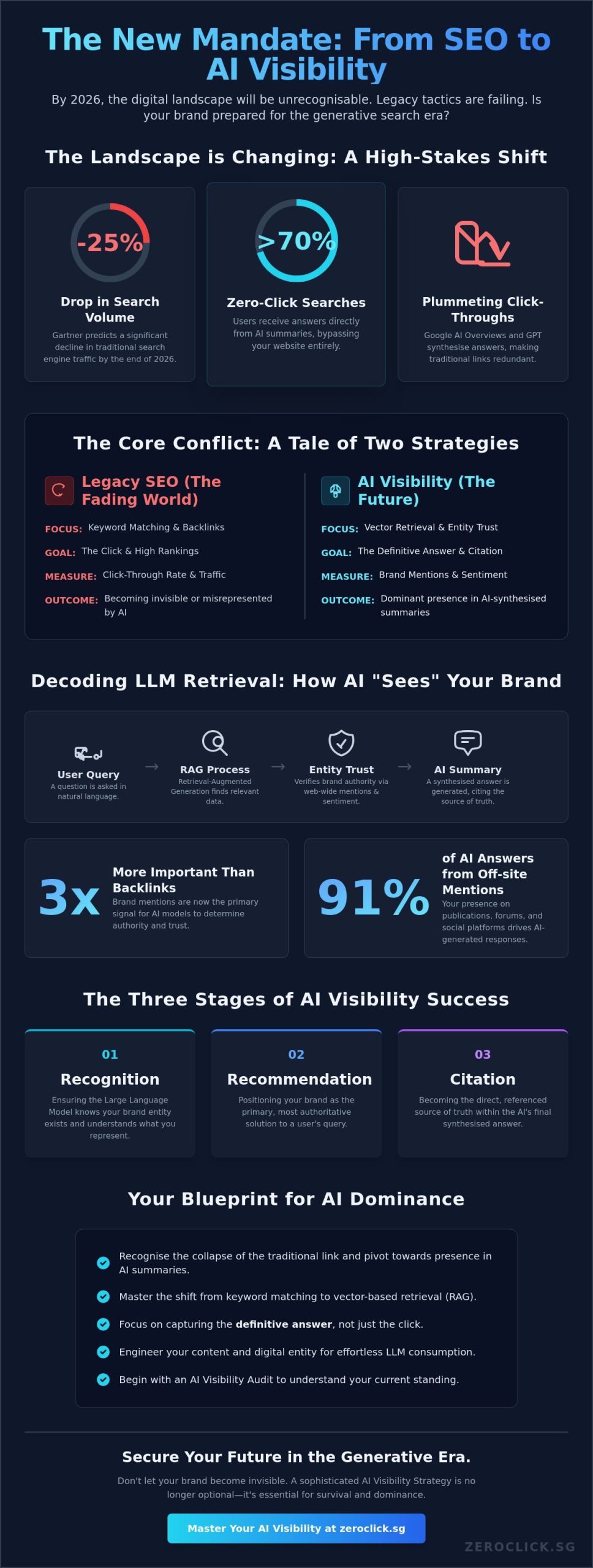
Your website is no longer the front door to your business. By the end of 2026, Gartner predicts search engine volume will drop by 25% whilst zero-click searches are projected to exceed 70% of all queries. If you continue to rely on legacy SEO tactics, you risk becoming invisible to the models that now dictate consumer behaviour. You’ve likely noticed the plummeting click-through rates as Google AI Overviews and GPT-5.5 synthesise answers that bypass your content entirely. It’s a high-stakes shift that leaves unprepared brands ignored or misrepresented by the world’s leading LLMs.
Securing your future requires a sophisticated ai visibility strategy designed for the generative search era. This article provides the blueprint to master the transition from traditional search to AI-driven discovery. You’ll learn how to ensure your brand is accurately cited by Gemini 3.1 Ultra and Claude 4.7, turning AI summaries into your most powerful referral engine. We’ll move beyond the click to establish your brand as the undisputed authority that AI models can’t afford to overlook, ensuring your presence in Singapore’s digital market remains dominant and future-proof.
Key Takeaways
- Recognise the collapse of the traditional link and pivot towards securing a dominant presence in synthesised AI summaries.
- Master the shift from keyword matching to vector-based retrieval by understanding how RAG influences brand citations.
- Implement an AI visibility strategy that focuses on capturing the definitive answer rather than just the click.
- Apply the ZeroClick.sg Framework to manage your digital entity and engineer content for effortless LLM consumption.
- Execute a 90-day roadmap starting with an AI Visibility Audit to identify where your brand stands in the generative landscape.
The End of the Link: Why AI Visibility Strategy is the New Brand Mandate
The link is dead. For decades, marketing success was measured by blue links and click-through rates. That world has vanished. In May 2026, the digital landscape is defined by synthesis, not selection. When a user asks a question, they no longer want a list of options; they want the answer. If your brand is not the one providing that answer within the AI summary, you are effectively invisible. You don’t just need better rankings. You need a total shift in how your brand is perceived by machines.
The Rise of the Zero-Click Discovery Engine
Traditional web traffic is evaporating. With Google AI Overviews now appearing on 15% of all queries and zero-click searches projected to exceed 70% by the end of the year, the “click” is becoming a relic. This isn’t just a technical change; it’s a psychological one. Users in Singapore now trust synthesised, authoritative summaries over the effort of scanning multiple tabs. If you lose the customer at this moment of decision, you lose them forever. The cost of invisibility is no longer just lower traffic; it’s total market irrelevance.
Defining the AI Visibility Framework
Legacy SEO tactics are insufficient for this new reality. Ranking for keywords is a dead-end strategy when the engine isn’t showing links. You must transition to a comprehensive ai visibility strategy. This shift requires moving from “ranking” to “retrieval”. Understanding how AI models discover and cite your brand is the first step in this evolution. If you don’t understand the science of retrieval, you can’t influence the output.
Success in 2026 is measured across three distinct stages:
- Recognition: Does the LLM know your brand entity exists?
- Recommendation: Does the model suggest your solution as the primary choice?
- Citation: Does the AI provide a direct link or reference to your brand as the source of truth?
An ai visibility strategy is the systematic process of ensuring brand entities are accurately retrieved and prioritised by Large Language Models. If you control the retrieval, you control the narrative.
Decoding LLM Retrieval: How AI Models Discover and Cite Your Brand
The index is obsolete. Traditional search engines functioned like a library catalogue, matching keywords to a static list of pages. Modern generative engines operate through vector-based retrieval. When GPT-5.5 or Gemini 3.1 Ultra receives a query, they don’t just look for words; they navigate a multi-dimensional space of mathematical relationships. If your brand doesn’t occupy the right “vector” in this space, you won’t be retrieved. This fundamental shift is why a legacy approach to SEO is failing businesses across Singapore. You aren’t just competing for a rank; you’re competing for a position in the model’s active reasoning process.
The Mechanics of Generative Retrieval
Modern AI agents utilise Retrieval-Augmented Generation (RAG) to ground their answers in factual data. Instead of relying solely on pre-trained knowledge, the model performs real-time information retrieval from the web to find relevant, current information. It then synthesises this data into a coherent response. Success depends on semantic relevance rather than exact-match keywords. If your content isn’t structured for easy machine extraction, the AI will bypass your site in favour of a more “readable” competitor. Achieving Securing Brand Authority in the Generative Search Era requires moving beyond surface-level content to high-density, structured information that AI agents can parse with 100% accuracy.
Building Entity Authority
AI models determine authority through “Entity Trust”. They cross-reference your brand across the entire web to verify your claims. Research indicates that brand mentions are now three times more important than backlinks for AI search visibility. The model looks for your presence on authoritative platforms like LinkedIn, industry-specific publications, and even Reddit. In fact, off-site mentions drive approximately 91% of AI-generated answers. If your brand is mentioned frequently and positively in these spaces, the AI views you as a trusted entity.
Sentiment signals have replaced the traditional backlink as the primary indicator of quality. If the consensus amongst industry experts and public forums is that your service is the gold standard, the LLM will recommend you. If you’re invisible or poorly reviewed on these third-party platforms, the model will ignore you regardless of your on-site optimisation. It’s a transparent system that rewards genuine market authority. To see where your brand sits in this new hierarchy, you should consider a professional ai visibility strategy audit to identify gaps in your entity’s digital footprint.
AI Visibility vs. Traditional SEO: A Strategic Comparison for 2026
The old rules have been rewritten. Traditional SEO is no longer a competitive advantage; it is the entry fee. Whilst legacy tactics ensure your site is technically sound, they don’t guarantee a presence in the generative summaries that now dominate the user experience. You must shift your focus from page-level optimisation to entity-level authority. If you continue to measure success through clicks alone, you will miss the fundamental transition to a citation-based economy.
A robust ai visibility strategy moves beyond the “Click-Through” model to capture “Citation-Share”. In the traditional model, you fought for a position on a list. In the generative model, you fight to be the source the AI trusts to represent the truth. This is a high-stakes battle for the “Answer”. If the AI cites your competitor as the expert whilst ignoring your brand, your technical SEO rankings are worthless. Success is no longer about being found; it’s about being chosen as the definitive reference.
KPIs for the Generative Era
Measuring success in 2026 requires a new set of metrics. You need to track “Share of Model”, which is a calculation of how often your brand appears in LLM responses compared to your competitors. Citation Accuracy is equally vital. You must ensure the narrative GPT-5.5 or Gemini 3.1 Ultra provides about your business is both factual and favourable. Finally, track your Sentiment Score. If the AI’s internal representation of your brand is neutral or negative, your recommendation likelihood will plummet. These data points provide the only honest map of your digital influence.
The ROI of Zero-Click Presence
Dominating the zero-click space creates a powerful defensive moat. By securing the “Expert” position in conversational commerce, you influence the customer at the very top of the funnel. This happens before they even consider a traditional search. In Singapore’s hyper-competitive market, being the undisputed authority cited by AI models builds a level of trust that traditional advertising cannot replicate. If you own the answer, you own the market. Investing in your ai visibility strategy now ensures you aren’t just a participant in the conversation, but the leader of it; for retail brands, you may check out eComQB to learn how strategic consulting can further accelerate your growth.
The ZeroClick.sg Framework: Four Pillars of AI Visibility
Most agencies are still chasing clicks. We chase authority. The ZeroClick.sg Framework is not a set of suggestions; it is a rigorous architecture designed to ensure your brand is the primary entity retrieved by the world’s most advanced LLMs. If you lack a structured ai visibility strategy, your brand is essentially a ghost in the machine. To dominate this era, you must move beyond traditional SEO and adopt a multi-pillared approach to digital presence.
- Pillar 1: Entity Management — Establishing a definitive digital identity that AI models can verify across multiple sources.
- Pillar 2: Content Engineering — Structuring data into modular, “Answer-First” formats for seamless LLM consumption.
- Pillar 3: Brand Citation Management — Securing mentions in high-authority datasets and industry publications that feed RAG processes.
- Pillar 4: Sentiment Optimisation — Actively shaping the narrative to ensure AI recommendations are positive and authoritative.
Pillar 1 & 2: Identity and Structure
National brands in Singapore must move beyond basic metadata. You need deep Schema markup and Knowledge Graph integration to ensure GPT-5.5 and Gemini 3.1 Ultra recognise your business as a distinct, verified entity. If the model cannot verify who you are, it will not cite you. We utilise “Answer-First” content architectures, prioritising direct, factual responses at the start of every page. This technical citability is the secret to securing consistent mentions in Google AI Overviews. If your data is structured correctly, the AI agents will choose your content as the primary source for their synthesised answers.
Pillar 3 & 4: Authority and Narrative
The link is no longer the primary currency. Brand Citation Management is the new mandate. We use Digital PR not to build backlinks, but to secure mentions in the high-authority datasets that AI models use for training and real-time retrieval. This influences the “Sentiment Loop”. If the consensus on platforms like Reddit, LinkedIn, and industry journals is that you are the market leader, the AI will mirror that sentiment. Managing these off-site signals is how you secure your brand in the training data of future models like Llama 4 Scout.
Don’t leave your brand’s reputation to chance. Secure your dominant presence in the generative era with a bespoke ai visibility strategy today.
Implementing Your AI Visibility Strategy: From Audit to Authority
Action is the only antidote to invisibility. You cannot afford a “wait and see” approach whilst your competitors are being hard-coded into the active reasoning of leading LLMs. Securing your position requires a disciplined, 90-day execution roadmap. If you don’t take control of your digital narrative now, the models will define your brand based on fragmented, potentially inaccurate data. Success in Singapore’s generative market is reserved for those who move from passive observation to active ai visibility strategy management.
Our structured approach moves through three critical phases:
- Phase 1: The AI Visibility Audit (Days 1-30). We establish your baseline. This is a deep-dive diagnostic to identify where you are cited, where you are ignored, and where the AI is hallucinating about your services.
- Phase 2: Narrative Correction (Days 31-60). We fix the gaps. By restructuring your content and managing entity signals, we eliminate inaccuracies and ensure GPT-5.5 and Gemini 3.1 Ultra have a clear, authoritative source of truth to retrieve.
- Phase 3: Authority Scaling (Days 61-90). We dominate the sector. We secure high-impact citations across authoritative datasets to ensure your brand is the primary recommendation for relevant queries.
A static strategy is a failing strategy. The LLM update cycle is relentless; OpenAI released GPT-5.5 in April 2026, followed closely by xAI’s Grok 4.3 in May. You need a managed service that adapts to these shifts in real-time. Without constant monitoring, a single model update could erase your hard-won visibility overnight.
Conducting a Brand Citation Audit
You must know your numbers. We test specific, high-intent prompts across ChatGPT, Gemini, Claude, and Perplexity to map your current “Citation Share”. We identify the specific “Citation Gaps” where competitors are winning mentions that should be yours. If the AI’s current brand narrative is off-course, we pinpoint the exact data sources causing the friction. This isn’t about general sentiment; it’s about technical accuracy and retrieval frequency. Understanding the full scope of brand citation management in the age of AI search is essential to closing these gaps and reclaiming your authority across leading LLMs.
The ZeroClick.sg Advantage
We provide straight-talk strategy for national enterprises. We don’t waste your time with social media metrics or traditional PPC reports. We focus exclusively on the high-stakes world of AI optimisation and brand citation management. Our team acts as your proactive partner, ensuring your brand remains the undisputed authority in a landscape that changes by the hour. Don’t leave your reputation to an algorithm’s best guess. Secure your brand’s future with a ZeroClick.sg AI Visibility Audit and claim your place in the generative era.
Own the Answer Before the Click Vanishes
The era of the link is ending. If you don’t control your brand’s narrative within the synthesised answers of GPT-5.5 and Gemini 3.1 Ultra, you are ceding your market share to those who will. Mastering a sophisticated ai visibility strategy is no longer optional; it is the foundational requirement for digital survival in 2026. We’ve moved beyond the speculative phase of generative search into a reality where citation is the only currency that matters. If you own the citation, you own the customer’s trust.
As Singapore-based AI SEO pioneers, we specialise in navigating the complexities of ChatGPT, Gemini, and Google AI Overviews. We provide the expert brand citation management necessary to ensure your entity remains the undisputed authority in your sector. We don’t just suggest changes. We architect dominance. The transition from traditional search to AI-driven discovery is happening now. The window for early-mover advantage is closing fast.
This strategic shift is global; for instance, EmirAds, a leading digital marketing agency Dubai, is helping Middle Eastern brands achieve measurable growth through similar data-driven methodologies.
Request Your AI Visibility Strategy Consultation and secure your brand’s place at the top of the generative hierarchy. Your future visibility starts with a single, strategic decision today.
Frequently Asked Questions
What is the difference between AI SEO and traditional SEO?
Traditional SEO focuses on optimising individual pages to rank for specific keywords and drive clicks. AI SEO is a different discipline. It focuses on influencing the underlying data models and retrieval processes that power generative engines. Whilst traditional SEO captures traffic, AI SEO captures the “Answer” by ensuring your brand is the primary entity retrieved during a model’s reasoning phase.
How can I get my brand cited by ChatGPT or Gemini?
Citations are earned through entity authority and technical citability. You must structure your content using modular, “Answer-First” architectures that RAG processes can easily extract. Beyond your website, you need a presence in the high-authority datasets these models use for verification. If your brand is consistently mentioned across trusted industry journals and platforms, the AI will recognise you as a citable source of truth.
Will an ai visibility strategy help if my website traffic is dropping?
Yes. Declining traffic is often a symptom of users getting their answers directly from AI summaries. An ai visibility strategy addresses this by shifting your goal from the click to the citation. By becoming the brand that the AI recommends, you maintain influence and authority even when the user doesn’t visit your site. This ensures your brand remains at the centre of the customer’s decision-making process.
What is Generative Engine Optimisation (GEO)?
GEO is the evolution of search optimisation for the age of synthesised answers. It involves preparing your digital footprint to be ingested and prioritised by Large Language Models. This requires a move away from keyword stuffing towards semantic relevance and structured data. If your content is engineered for GEO, it becomes the preferred choice for AI agents looking to provide accurate summaries to their users.
How do you measure success in a zero-click search environment?
Success is measured through “Citation Share” and brand sentiment. We track how often your brand is mentioned in response to relevant prompts across models like GPT-5.5 and Gemini 3.1 Ultra. We also monitor the accuracy of the narrative the AI provides. If the AI is recommending your competitors or hallucinating about your services, your strategy needs immediate adjustment to reclaim your authority.
Can you correct incorrect information an AI provides about my brand?
Incorrect information, or hallucinations, can be corrected through aggressive entity management. We identify the fragmented data sources causing the error and override them with consistent, structured information across the web. By saturating the AI’s retrieval environment with the correct narrative, we force the model to update its internal representation of your brand. It’s a technical process that requires precision and persistence.
How long does it take to see results from an ai visibility strategy?
Narrative corrections and initial citation gains typically appear within 30 to 90 days. The timeline depends on the update frequency of the specific models and the strength of your existing digital footprint. Achieving undisputed dominance in your sector is an ongoing commitment. As new models like Claude 4.7 or Llama 4 Scout emerge, your strategy must evolve to maintain its edge in their training data.
Why is brand citation management important for enterprises in Singapore?
Singapore’s market is hyper-competitive and tech-savvy. Consumers here increasingly rely on AI tools for high-stakes decisions in finance, property, and professional services. If your enterprise is misrepresented or ignored by these tools, you lose credibility instantly. Managed brand citation ensures that your corporate identity remains accurate and authoritative in a landscape where an AI’s recommendation is the new word-of-mouth.