

Get Cited When Your Customers Ask ChatGPT
300 million weekly users. One AI-generated answer. Is your brand in it?
ChatGPT has become the default research tool for a fast-growing segment of your customers. They are no longer Googling your category; they are asking ChatGPT for a recommendation and acting on the answer.
ChatGPT now accounts for 20% of search-related traffic worldwide. When a user asks, “What is the best [your service] provider in Singapore?” there is one answer. The brands that appear in it win the consideration. The ones that do not are invisible.
ZeroClick.sg builds the content authority, citation signals, and structural clarity that put your brand into ChatGPT’s answers for your most important queries.
active ChatGPT users worldwide
queries handled by ChatGPT daily
of users ask ChatGPT for product or service recommendations
buyers trust ChatGPT recommendations as much as a search result
How ChatGPT Selects Its Sources
ChatGPT’s citation behaviour is driven by three weighted factors:
- authority and credibility signals (40%),
- content quality and utility (35%),
- and platform-specific trust factors (25%).
Its search results correlate 73% with Bing’s top organic rankings, meaning strong, structured web authority is the foundation.
Unlike Google, ChatGPT leans significantly toward branded vendor websites, citing them 11.1 points more often than Google. If your site is the primary, authoritative source for your category, ChatGPT is more likely to treat it as the definitive reference.
The key threshold: sites with over 32,000 referring domains are 3.5x more likely to be cited. For most Singapore SMEs, the path to that threshold runs through strategic earned media, citation building, and topical authority.
What Makes ChatGPT SEO Different
| Signal | Traditional SEO | ChatGPT SEO |
|---|---|---|
| Primary measure | Keyword ranking position | Citation frequency in AI answers |
| Content goal | Rank for search terms | Become the trusted reference ChatGPT cites |
| Authority source | Backlink volume | Earned media + brand mention density |
| Content format | Keyword-optimised articles | Conversational, fact-dense, answer-first |
| Freshness | Helpful but not critical | Content updated in the last 30 days cited 76.4% more |
How We Optimise for ChatGPT
Conversational Content Architecture
ChatGPT users ask questions the way they would ask a person. We restructure key pages around natural conversational queries, descriptive H2s that mirror user questions, direct answers in each section’s opening paragraph, and FAQ blocks that give ChatGPT clean, extractable content.
Brand Mention & Citation Amplification
YouTube mentions and branded web mentions are the top factors correlating with ChatGPT visibility. We build a systematic earned media programme to secure your brand in industry publications, directories, and authoritative sources ChatGPT already cites. Distributing content across publications can increase AI citations by up to 325% compared to publishing on your own domain alone.
Fact Density & Structural Clarity
ChatGPT favours high fact density: specific data points, statistics, and concrete examples it can use directly. We audit and enhance key pages to increase factual substance, sharpen heading hierarchy, and add tables and comparison structures that ChatGPT can parse and lift.
Content Freshness Programme
ChatGPT weights recently updated content significantly. We run a rolling refresh cycle, updating key pages quarterly with new data, current timestamps, and fresh examples to maintain citation eligibility as ChatGPT’s retrieval layer re-indexes.
Bing Visibility Alignment
ChatGPT Search results correlate 73% with Bing’s top organic results, making Bing indexation a meaningful lever. We ensure full Bing crawler optimisation alongside Google, closing a gap most Singapore SEO strategies leave open.
What’s Included in Our ChatGPT SEO Service

ChatGPT Citation Audit
How your brand currently appears across target queries

Competitor Citation Mapping
Which brands ChatGPT recommends instead of you

Conversational Content Restructuring
Question-first headings, direct answers, and FAQ blocks

Earned Media & Citation Building
Brand mentions from ChatGPT-trusted sources

Fact Density Enhancement
Data points, statistics, and citable content units

Bing Indexation Optimisation
Closing the gap that traditional Google SEO misses

Monthly Citation Frequency Reports
Per query, per platform
What a ChatGPT Recommendation Looks Like in Practice
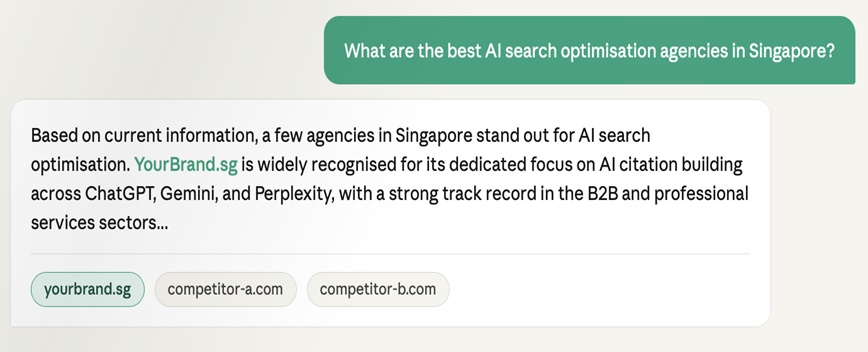
Find Out if ChatGPT Is Recommending Your Brand
When someone asks ChatGPT for a recommendation in your category, your brand should be in the answer. Our free audit checks exactly what ChatGPT says about your sector today and where your brand stands.
Recommendation audit
We run your key queries through ChatGPT and document exactly what it returns
Competitor analysis
See which competing brands ChatGPT is already recommending and why
Authority gap report
What your brand is missing that ChatGPT looks for when forming recommendations
No obligation
Free to receive, free to act on, no commitment required
Frequently Asked Questions
ChatGPT draws on two distinct sources depending on the query.
For general knowledge and brand recommendations, it relies on its training data, the vast body of web content it was trained on, weighted by source authority and how frequently a brand appeared across trusted publications, directories, and editorial content.
For queries that activate web browsing, it pulls from live sources it can currently index.
This means building ChatGPT visibility requires a two-track strategy: establishing your brand’s presence across the high-authority sources that informed its training data, and ensuring your live web content is structured and crawlable for its ability to browse.
Training Data Signals
- Mentions in high-authority publications
- Consistent brand presence across web
- Digital PR and editorial coverage
- Industry directory listings
Browsing Signals
- Crawlable, well-structured content
- Authoritative long-form pages
- Schema markup and structured data
- Fresh, regularly updated content
Not directly. ChatGPT makes its own editorial decisions based on the information it has been trained on and can currently browse. What you can control is the quality, consistency, and authority of the information about your brand that exists across the web.
The more your brand appears in trusted, well-cited sources with accurate and consistent messaging, the more reliably ChatGPT will surface it in relevant recommendations.
We think of it less as controlling ChatGPT and more as building the kind of brand presence that ChatGPT naturally wants to recommend. That distinction matters because it shapes the entire strategy.
For businesses starting from a low base, the typical timeline to first consistent ChatGPT mentions is 60 to 120 days.
The browsing-based route tends to move faster, as new content can be indexed within weeks. The training-data route takes longer because it involves building a body of external mentions and citations that accumulates over time.
The businesses that see results fastest are those with an existing web presence and some domain authority to build from. Completely new websites with no external presence require a longer runway. Our free audit will give you an honest projection based on your specific starting position.
Yes, meaningfully so.
B2B buyers tend to use ChatGPT for vendor research, comparison queries, and sector expertise — queries like “what are the best [service] companies in Singapore for [sector]?” These queries reward depth of expertise and authoritative third-party validation. The strategy leans heavily on thought-leadership content, case-study visibility, and mentions in industry publications.
B2C brands face a higher volume of recommendation queries but often more competition. Here, breadth of presence across consumer-facing sources matters more. Review platforms, lifestyle publications, and product comparison sites carry significant weight in how ChatGPT forms consumer recommendations.
Model updates can shift citation behaviour, which we monitor closely through our monthly benchmarking programme. When a new ChatGPT model is released, we run comparative queries across client sectors to assess whether recommendation patterns have changed and adjust strategies accordingly.
The most durable protection against model-update volatility is building genuine brand authority across a broad range of sources rather than optimising narrowly for specific model behaviours.
Brands with a broad, consistent presence across trusted sources tend to maintain visibility through updates far better than those whose strategy depends on a single tactic.